


South East Asia - Life World Library
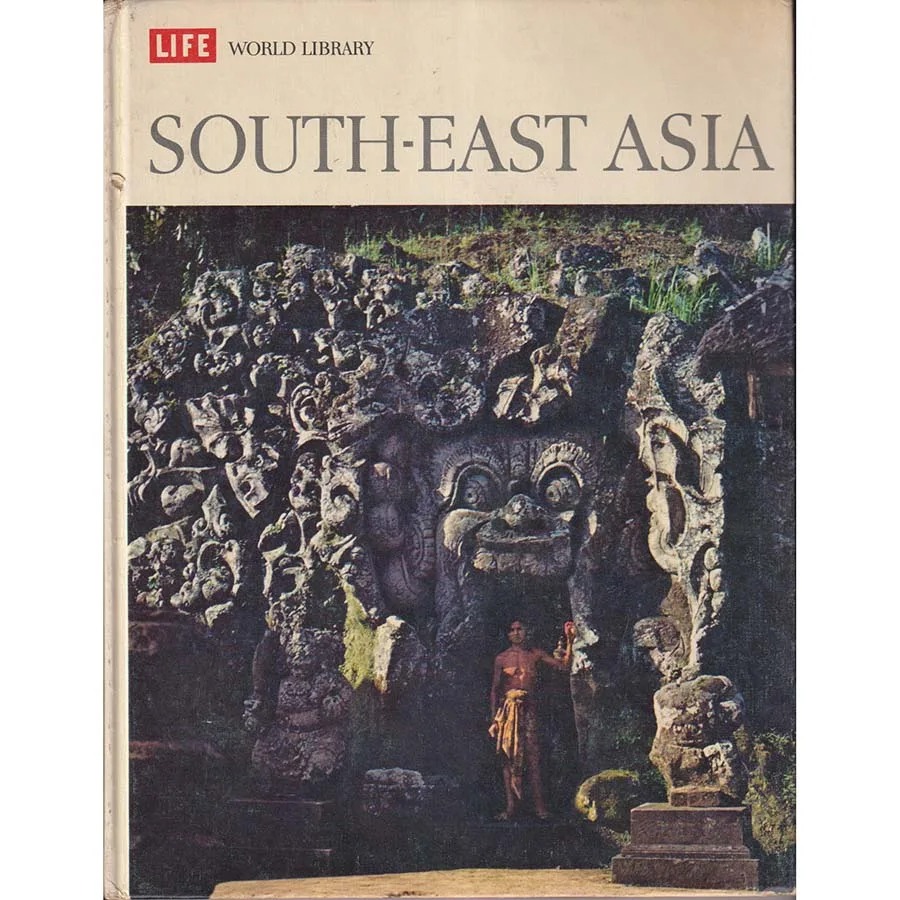
Publisher: Time-Life International
Format: Hardback
ISBN: none
South East Asia (1964) by Stanley Karnow – Time-Life International
ISBN: None
Condition: Fair
South East Asia, 1964. Jungles, rice fields, rapidly growing cities, colonial leftovers, communist insurgencies, newly independent nations and enough geopolitical tension to ensure that anybody producing a reference book on the region had chosen a particularly inconvenient moment to declare the information finished.
Written by Stanley Karnow and published by Time-Life International, South East Asia is a fascinating illustrated portrait of one of the most complicated regions in the world at a moment when virtually everything seemed to be changing at once.
And 1964 was not exactly a quiet year.
Vietnam was sliding ever deeper into war.
Laos was unstable.
Cambodia was attempting to remain neutral.
Indonesia was confronting the newly formed Malaysia.
Singapore was still part of Malaysia and would not become an independent state until the following year.
The Philippines was developing as a post-colonial republic.
Thailand was firmly aligned with the United States.
And throughout the region, the Cold War had turned tropical geography into international strategy.
So if you are looking for a peaceful vintage travel book containing nothing more controversial than temple opening times and recommendations for a pleasant beach, this may require slightly more concentration.
The term South East Asia itself covers an extraordinary variety of countries and peoples.
Vietnam.
Thailand.
Cambodia.
Laos.
Burma, now Myanmar.
Malaysia.
Singapore.
Indonesia.
The Philippines.
And surrounding territories and islands, all possessing different languages, religions, histories and political systems.
Europe spent several centuries helpfully ensuring that the colonial history was equally varied.
Britain had bits.
France had bits.
The Netherlands had an enormous collection of islands.
Spain had previously controlled the Philippines before the Americans became involved.
Portugal hung on in places.
Japan invaded much of the region during the Second World War.
By the time independence arrived, almost everybody had left behind borders, institutions, railways, administrative systems and several unresolved problems.
Nation-building therefore began with a certain amount of inherited paperwork.
Stanley Karnow was particularly well suited to writing about the region.
An American journalist and historian, he reported extensively from Asia and would later become especially well known for his work on Vietnam.
He was not approaching South East Asia merely as someone who had stepped off an aeroplane, taken several photographs of temples and returned home with strong opinions about noodles.
He had first-hand experience of the political forces transforming the region.
That matters particularly in a book published in 1964, because events were moving remarkably quickly.
Vietnam naturally hangs heavily over the period.
The country had already been divided into communist North Vietnam and the anti-communist South following the end of French colonial rule.
The United States was steadily increasing its involvement.
American military advisers were already present in large numbers.
The Gulf of Tonkin incident occurred in August 1964, dramatically accelerating American participation in the conflict.
The enormous US combat deployment associated with the Vietnam War would follow.
So this book captures South East Asia at almost the precise moment before the Vietnam War became one of the defining international events of the late twentieth century.
There is no hindsight.
Nobody has yet watched the helicopters leave Saigon in 1975.
Nobody knows exactly how badly the war will escalate.
Nobody knows how many governments will fall, how many lives will be lost or how dramatically the conflict will reshape American politics.
That is one of the peculiar pleasures of old reference books.
The people in them are walking towards history without knowing which photographs will later appear in documentaries.
Cambodia is equally striking in retrospect.
In 1964, Prince Norodom Sihanouk was attempting to steer the country through the Cold War while maintaining a complicated neutrality.
The Khmer Rouge had not yet seized power.
The horrors of the Cambodian genocide were still more than a decade away.
Phnom Penh was a functioning and comparatively elegant capital.
The future had not yet become catastrophic.
Looking at period photographs with that knowledge is inevitably unsettling.
Old books sometimes acquire significance their publishers could never have anticipated.
A photograph intended simply to illustrate everyday life becomes evidence of a vanished world.
Laos was similarly caught in political conflict.
Royalists.
Neutralists.
Communists.
Foreign powers.
The country became one of the quieter but strategically important theatres of the wider Indochina struggle.
And, as frequently happens in international politics, a country most outsiders struggled to locate on a map became extremely important to governments thousands of miles away.
Thailand followed a different path.
Never formally colonised by a European power, it maintained its independence through a long history of careful diplomacy and political adaptation.
By the 1960s it was closely aligned with the United States and would become a major base for American operations during the Vietnam War.
Bangkok, meanwhile, was already expanding rapidly.
But the city shown here predates much of the modern skyline, expressways and enormous commercial development familiar today.
Which makes the street photography especially interesting.
Old buses.
Old cars.
Canals.
Markets.
Shopfronts.
Buildings that may no longer exist.
The ordinary bits are often the best bits.
A spectacular temple will probably still be there.
The bus definitely isn’t.
Burma, now officially Myanmar, was also following its own turbulent path.
Having gained independence from Britain in 1948, it experienced political instability before General Ne Win seized power in a military coup in 1962.
By the time this book was published, Burma had embarked on the authoritarian and economically disastrous “Burmese Way to Socialism”.
Which is the sort of phrase that sounds much more reassuring in a government document than it often proves in practice.
The country became increasingly isolated.
So photographs from this period show a Burma that modern readers may find particularly evocative: before decades of isolation transformed much of its political and economic life.
Malaysia was even newer.
The Federation of Malaysia had been formed only in 1963, bringing together Malaya, Sabah, Sarawak and Singapore.
Indonesia strongly opposed the new federation and launched the period known as Konfrontasi, or Confrontation.
This involved armed incursions, political pressure and fighting along parts of the border.
Again, the region’s political map was not merely young.
It was still arguing about whether it should exist.
Singapore, meanwhile, was still part of Malaysia when this volume appeared.
It would become independent in 1965.
The Singapore shown here therefore predates the extraordinary transformation that would turn it into one of the world’s great financial and commercial centres.
Modern Singapore is known for skyscrapers, container ports, immaculate transport and regulations concerning activities other countries would barely think to regulate.
The 1964 version was a very different place.
Crowded.
Commercial.
Strategically important.
Still containing areas of poverty and traditional urban life.
And entirely unaware that future generations would use phrases such as “global financial hub” with exhausting frequency.
Indonesia presents another scale entirely.
Thousands of islands.
Hundreds of ethnic groups.
A vast population.
Volcanoes.
Rainforests.
Major cities.
And the logistical inconvenience of attempting to administer a country scattered across an enormous archipelago.
Indonesia had achieved independence from Dutch rule only in the late 1940s.
President Sukarno dominated political life in the early 1960s, pursuing a highly nationalist and increasingly confrontational foreign policy.
Again, the timing is fascinating.
Only a year after this book appeared, Indonesia would enter the catastrophic political upheaval of 1965–66, during which hundreds of thousands of people were killed following an attempted coup and subsequent anti-communist purge.
Suharto would eventually replace Sukarno.
None of that has happened yet here.
This is Indonesia before the next chapter.
The Philippines, meanwhile, carried the complicated legacy of Spanish and American colonial rule.
Independent since 1946, it had close ties with the United States and a political system heavily influenced by American institutions.
Manila was rebuilding and expanding after the enormous destruction it suffered during the Second World War.
The country was modernising, but inequality, land ownership and political corruption remained serious issues.
Ferdinand Marcos had not yet become president.
That would happen in 1965.
Once again, the book manages to stand almost directly before another major historical turning point.
Apparently somebody at Time-Life had exceptional timing.
The geography of the region is no less dramatic than the politics.
Dense tropical forests.
Huge river deltas.
Mountain ranges.
Volcanoes.
Rice-growing plains.
Coral seas.
Thousands upon thousands of islands.
Some countries seem designed by geography to make administration inconvenient.
Indonesia may be the world champion.
Transport therefore features heavily.
Boats.
Ferries.
River craft.
Railways.
Buses.
Aircraft.
And roads that in 1964 might range from excellent to something requiring optimism, spare parts and perhaps a religious offering.
In many parts of the region, rivers remained major highways.
The Mekong in particular cuts through or along several countries and has shaped settlement, agriculture and trade for generations.
Before bridges and modern road networks expanded, water often provided the most practical route from one place to another.
The rice fields are another unavoidable image.
Rice is not merely food in much of South East Asia.
It is agriculture, employment, culture and economics.
Terraced hillsides, flooded paddies and enormous delta regions support populations on a scale difficult to appreciate from countries where rice historically arrived in small packets from the grocer.
Farming in 1964 was still far more labour-intensive than today.
Photographs of agricultural work therefore preserve methods, clothing, tools and rural landscapes that have since changed dramatically.
And as always with vintage Time-Life photography, seemingly ordinary scenes have aged wonderfully.
A street market.
A railway station.
A harbour.
A bicycle.
A petrol pump.
A child standing beside a shop.
The publishers probably considered such images documentary background.
Today they may be the most fascinating pages in the book.
Because cities change faster than monuments.
A temple can survive seven hundred years.
A bus route struggles to survive seven.
There is also the unavoidable legacy of European colonialism.
French Indochina.
British Malaya.
Dutch East Indies.
Spanish and American Philippines.
Colonial architecture remains visible in cities across the region.
Railways follow routes designed for colonial trade.
Ports were developed to export commodities.
Administrative boundaries became international borders.
And independent governments inherited economies often structured around exporting rubber, tin, rice, oil, spices and other resources to distant markets.
Rubber alone had been enormously important.
So had tin.
Oil.
Tea.
Coffee.
Spices.
The region had spent centuries attracting Europeans who arrived looking for valuable commodities and occasionally remained long enough to redesign the government.
The irony of modern tourism is that Europeans now travel back in large numbers to admire the architecture left behind by previous Europeans.
History has excellent repeat business.
Religion and culture add another enormous layer.
Buddhism dominates much of mainland South East Asia.
Islam is central to Indonesia and Malaysia.
Christianity is particularly important in the Philippines.
Hindu traditions remain influential in Bali.
Chinese communities have shaped trade and urban life across much of the region.
Indigenous beliefs and local traditions continue alongside all of them.
So any attempt to describe a single “South East Asian culture” quickly collapses under the weight of reality.
Even the food refuses cooperation.
Thai cuisine is not Vietnamese cuisine.
Vietnamese cuisine is not Indonesian cuisine.
Indonesian cuisine is not Filipino cuisine.
Malaysia adds Malay, Chinese and Indian traditions together and then makes the whole subject even more difficult.
The result is one of the richest culinary regions in the world.
Fortunately, this was 1964, before every dish needed to be photographed from directly above.
People simply ate it.
A bold concept.
Tourism was still comparatively limited in many parts of the region.
Thailand had visitors.
Singapore had travellers.
Bali had already attracted artists and adventurous tourists.
But mass international tourism on today’s scale did not exist.
There were no endless online hotel reviews complaining that breakfast finished at 10 rather than 10:30.
No budget airlines depositing stag parties onto tropical islands.
No influencer standing in front of an ancient temple while explaining that they had “discovered” it.
This gives the photographs a very different atmosphere.
Some locations now famous for tourism appear astonishingly quiet.
Beaches look like beaches rather than commercial ecosystems.
Historic sites appear to contain enough space to walk around them.
Modern readers may regard this as CGI.
The physical book itself is classic Time-Life.
Substantial.
Illustrated.
Authoritative.
Designed for an era when understanding another part of the world required an object heavy enough to injure your foot if dropped.
A shelf of these volumes effectively became a domestic foreign office.
China.
Canada.
Greece.
The West Indies.
South East Asia.
Arrange them correctly and visitors might assume you regularly corresponded with ambassadors.
No need actually to read them all.
The bookshelf handled much of the intellectual signalling.
There is also no software involved.
No login.
No monthly subscription.
No request to prove you are not a robot.
No “accept all cookies”.
Open the cover and the content appears immediately.
Battery life: indefinite.
Screen glare: zero.
Software support ended in approximately 1964 and yet remarkably the system still functions.
For today’s reader, South East Asia is far more than an old geographical survey.
It has become a fascinating mixture of Cold War history, decolonisation, Vietnam-era politics, social history, travel, geography and mid-century photography.
Its timing is exceptional.
Vietnam is on the edge of massive escalation.
Singapore is not yet independent.
Indonesia has not yet undergone the upheaval of 1965.
Ferdinand Marcos has not yet taken power in the Philippines.
Cambodia has not descended into the catastrophe of the Khmer Rouge years.
The modern region is visible, but unfinished.
That makes the book particularly rewarding for anyone who enjoys knowing what happens next.
Obviously, it is not a current travel guide.
Do not use it for visas.
Do not rely on the borders without checking.
Do not telephone any hotel number printed inside.
And if the book describes somewhere as an isolated fishing village, there is a reasonable possibility it now contains an international airport, six hundred hotels and a branch of Starbucks.
But that is exactly why it has aged so well.
The places changed.
The photographs did not.
Condition: Fair. There is a slight crack to the rear inner cover hinge, although the binding itself remains good and the book is still perfectly usable. The weakness could be readily reinforced with a small strip of glued paper or suitable tape if desired.
We have left it as it is because book repair creates its own philosophical dilemma.
Some people demand untouched originality.
Others would apply a discreet repair in thirty seconds and never think about it again.
Either approach is valid.
At present the book is not dramatically disintegrating like an ancient manuscript exposed to oxygen. It simply has a slightly tired rear hinge after more than sixty years of carrying the entire political, geographical and cultural complexity of South East Asia.
Frankly, it has earned it.
A fascinating vintage volume for collectors of South East Asian history, Vietnam War material, Cold War history, decolonisation, Time-Life books, geography or 1960s photography.
Also ideal for anyone wanting to travel from Burma to Indonesia without visas, tropical humidity, vaccinations, mosquitoes, military coups or discovering that the ferry shown on the timetable stopped operating in 1987.
Sold by Crappy Old Books, where the binding may be slightly cracked, the geopolitics are spectacularly out of date, and unlike much of South East Asia in 1964, the book remains reassuringly stable.
Keep browsing: See more Travel books Other books by Stanley Karnow
